
Relays
Relays
Communication Architecture
A Relay is an intermediary component within the CIQ ITAM and CIQ DEX architecture responsible for routing data between devices running the installed agents and the Almaden cloud. It operates as a logical forwarding point, receiving consolidated data from the agents and transmitting this information to the platform, where it is processed and made available.
Any device with the Desktop Agent or Server Agent installed can be configured to operate as a Relay.
How the Relay Works
- Endpoints (desktops, laptops, or servers) run the Desktop Agent or Server Agent.
- The agents collect data at defined intervals, following periodic consolidation cycles.
- After each collection/consolidation cycle, the agents send the data directly to the cloud or route it through a Relay according to the selected topology.
- The Relay receives these consolidated data batches and forwards them to the CIQ ITAM and CIQ DEX cloud services.
- The platform processes the information and makes it available in the portal.
Prerequisites
The architecture supports three communication topologies. The topology is selected during the agent download process; once installed, the agent automatically applies the selected configuration.
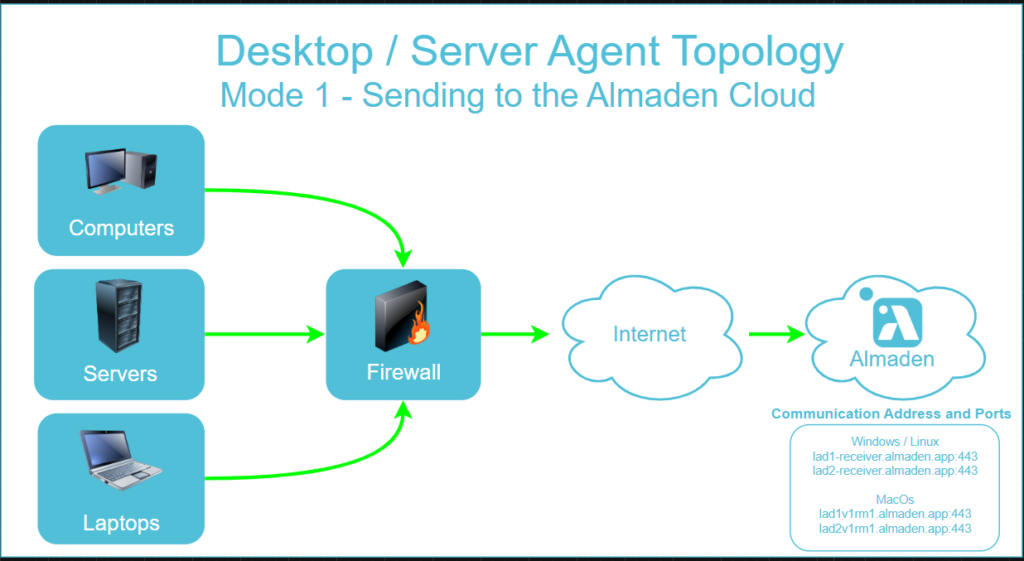
1 – Direct Transmission to Almaden Cloud
In this topology:
- The agent sends its consolidated data directly to the CIQ ITAM and CIQ DEX cloud.
- Suitable for devices with unrestricted internet access.
- No intermediaries are used.
Advantages:
- Lower complexity.
- Fewer dependencies and points of failure.
- Ideal for remote or home-office laptops and external devices.
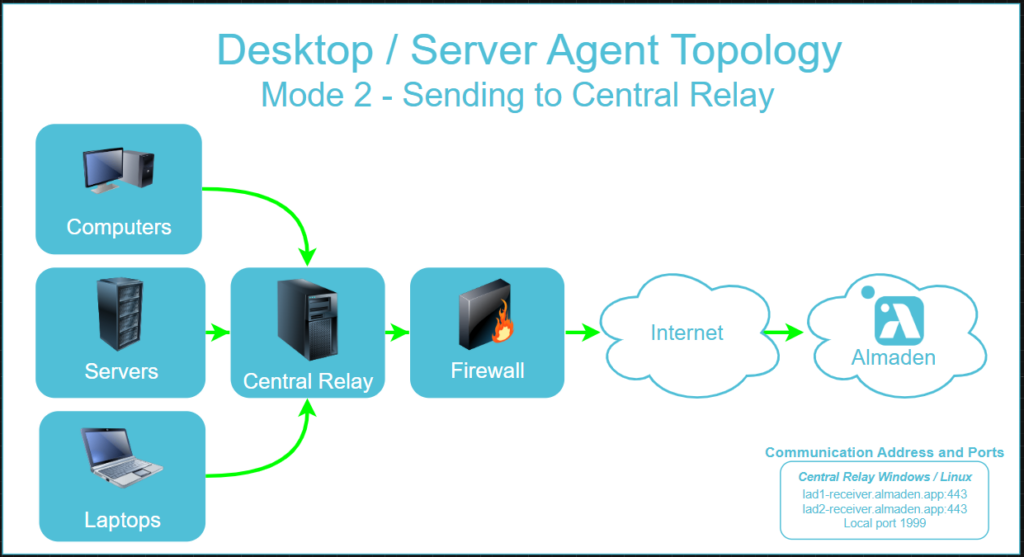
2 – Transmission via Central Relays
In this topology:
- Endpoints send their consolidated data packages to one or more Central Relays.
- The Central Relay forwards this information to the cloud.
- Recommended when devices do not have direct internet access, but can communicate with the Central Relay inside the corporate network.
Recommendations:
- At least one Central Relay must have outbound traffic allowed to the Almaden cloud.
- For large-scale deployments, it is recommended to use:
- Two Central Relays for redundancy and availability.
- Required when more than 20,000 Desktop Agents or 300 Server Agents consolidate through the same Central Relay.
3 – Transmission via Central Relay + Local Relay
In this topology:
- The agent sends data to a Local Relay.
- The Local Relay forwards the data to the Central Relay.
- The Central Relay transmits the data to the cloud.
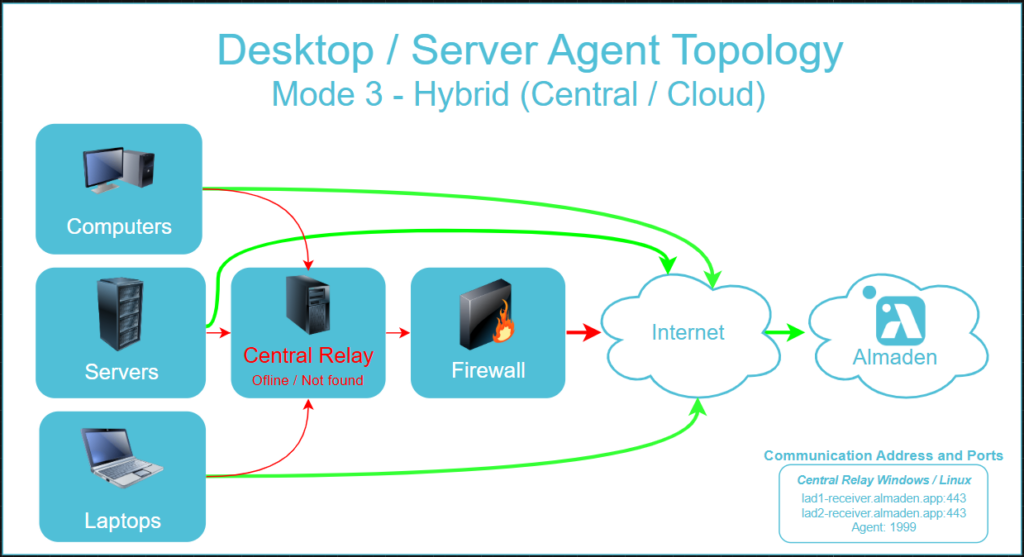
This flow is ideal for hybrid workplace scenarios where:
- Inside the corporate network: devices do not have internet access, but can reach the Local Relay.
- In home office: the same devices do have internet access and can send data directly to the cloud.
Typical flow:
- Corporate network → Local Relay → Central Relay → Cloud
- Home office → Direct Transmission → Cloud
Advantages:
- Automatic adaptation to hybrid workforce scenarios.
- Maintains compatibility with restricted corporate networks.
- Ensures continuity of data collection and consolidation.
Topology Selection
Topology is defined:
- In the portal during the agent download process.
- The installer is generated with the selected configuration embedded.
- During installation, the agent automatically applies:
- Relay definitions,
- Routing rules,
- Consolidation and transmission cycle configurations.
Infrastructure Considerations
Network Requirements
- Outbound traffic must be allowed for the Central Relay to communicate with the Almaden cloud.
- Internal traffic between endpoints, Local Relays, and Central Relays must be permitted.
- Proper DNS and FQDN configuration when applicable.
High Availability
For high-load or large-scale environments:
- Always deploy two Central Relays for redundancy.
- Distribute load between them.
- Ensure both have network access to the Almaden cloud.
Conclusion
Relays play a critical role in optimizing the transmission of consolidated data collected by the CIQ ITAM and CIQ DEX agents. The three available topologies — direct transmission, central relay routing, and hybrid local+central relay routing — allow organizations to operate efficiently regardless of network restrictions, ensuring scalability, flexibility, and secure data flow.
